01
Duty cycle
How many times a day the belt is fastened and released. A bus seat and a private car seat differ by orders of magnitude, and wear behaviour follows.

Applications
Duty cycle, mounting geometry and the regulation the vehicle is built to all change what the correct assembly looks like. These are the applications we are most often asked about.
Variables / 01
01
How many times a day the belt is fastened and released. A bus seat and a private car seat differ by orders of magnitude, and wear behaviour follows.
02
Where the anchorage points are, what they are attached to, and how much room there is to route webbing between them.
03
Bench or individual, fixed or folding, integrated headrest or not — all of which change where the belt can sit on the occupant.
04
Which framework the vehicle is homologated against, which is decided by the vehicle category and the market it is sold in.

01Front seating position, three-point belt
Application 01
The most familiar case, and the one with the least room for variation. Front and outboard rear positions normally take a three-point assembly with a retractor; the centre rear position takes either a three-point layout or a lap belt depending on whether an upper anchorage exists in the roof or seat structure.
What usually needs settling here is fit rather than format — belt length, where the D-ring or height adjuster puts the shoulder belt on a range of occupant heights, and whether the latch plate falls somewhere a seated person can actually reach.
02Belt in service during a journey
Application 02
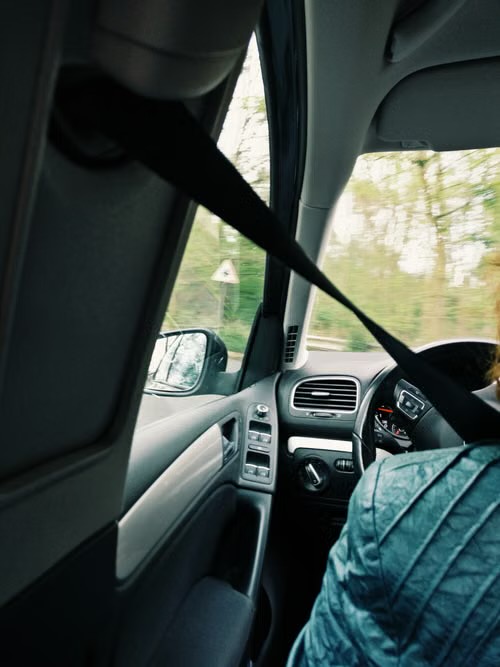
Cab belts are fastened and released far more often than private car belts — every drop, every stop, every driver change. That makes cycle behaviour the dominant concern: a buckle that is merely adequate at ten thousand cycles is a warranty problem at fifty.
Mounting is different too. Anchorage points sit on heavier structure, seats are frequently air-suspended or otherwise mobile relative to the cab, and fixings are rarely the same as a passenger car's. Belt length and anchorage hardware are specified accordingly.
Fig. 03 Repeated seating positionsIndicative layout
Application 03
Passenger transport turns a component decision into a multiplication problem. One specification is repeated across every seating position in the vehicle, and then across every vehicle in the fleet — so a small inconsistency in the assembly is not a small problem, it is the same problem hundreds of times.
Belts here are used by people who did not choose them, do not own them and will not be gentle with them. Durability of the buckle mechanism and of the retraction action matters more than initial fit, and replacement assemblies have to match what is already installed rather than merely being equivalent.
04Two-point lap belts on a bench seat
Application 04
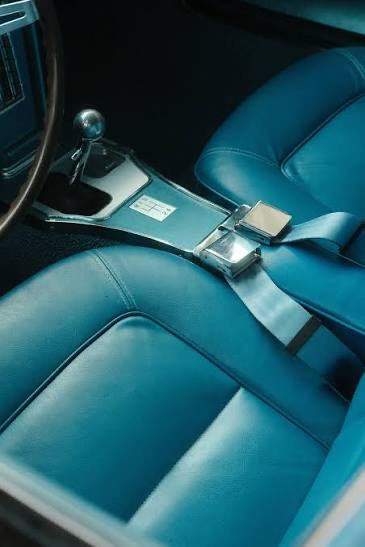
This is where standard catalogue parts stop being useful. Pickups, vans, light utility bodies, low-volume builds, restorations and modified vehicles all share the same characteristic: the seat and the mounting points came first, and the belt has to be built around them.
Bench seats, folding seats and seats mounted to a body rather than a floorpan all change the geometry. In some of these vehicles a two-point lap assembly is not a compromise but the correct answer, because no upper anchorage exists and inventing one would be worse than not having it.
Fig. 05 Seat-frame anchoringIndicative only
Application 05
Operator seating on plant and equipment presents a different problem again: the restraint anchors to the seat frame rather than to a vehicle body. That changes the load path, the fixings and often the belt format, because a seat that rotates or slides cannot rely on anchorages that stay still relative to a cab.
Environment matters more here too. Seats live in dust, vibration and outdoor exposure, and belts are frequently operated with gloves — which puts a practical floor under how small a release button can usefully be.
Enquiries
Describe the seat and the mounting points — photographs help more than part numbers. We will tell you what the sensible options are.