A
Belt format
Three-point or two-point lap; retractor or fixed length; which seating position the belt serves.
Product Range
Six categories, supplied individually or as a complete matched assembly. Every item is specified against an application rather than sold from a fixed list.
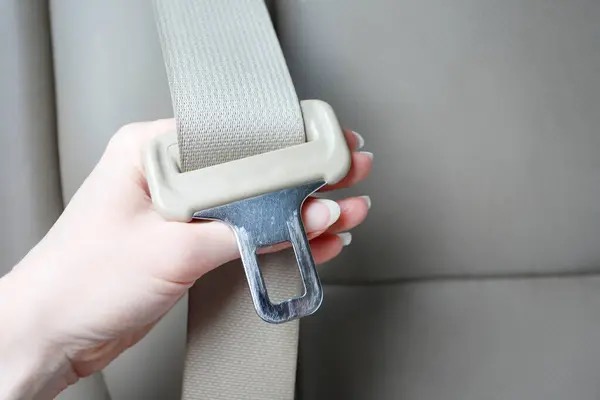
01Latch plate and webbing on a fitted assembly
Category 01
A complete assembly is the whole restraint supplied as one item: webbing cut and finished to length, the retractor, the latch plate, the buckle and the anchorage hardware, built and inspected together rather than gathered from separate sources and hoped to fit.
Both common formats are covered. Three-point assemblies route webbing across the shoulder and the lap from a single continuous length and are standard in forward-facing seating. Two-point lap assemblies restrain across the pelvis only and remain the correct choice in some centre, bench and specialty positions where a shoulder anchorage does not exist.
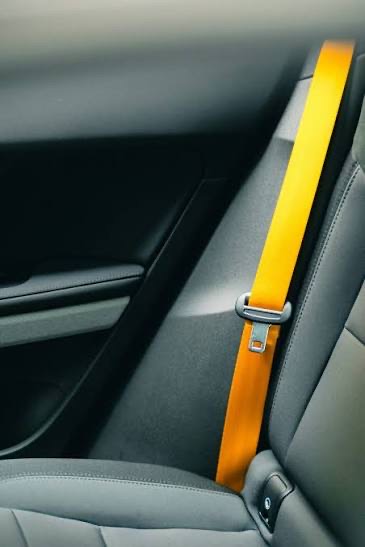
02High-visibility webbing with latch plate
Category 02
Webbing is the load-carrying member of a restraint. When a vehicle decelerates, it is the webbing that spreads force across the pelvis and rib cage instead of concentrating it, and the webbing's woven construction that lets the belt stretch in a controlled way so the deceleration is taken over a longer distance rather than as a single shock.
That makes consistency in width, thickness and weave fundamental rather than cosmetic. Two rolls that look identical but elongate differently produce two assemblies that behave differently, which is why incoming webbing is checked before it is committed to a build.
Webbing is supplied on the roll, or cut to length with the ends edge-finished so they do not fray in service. Standard dark colours cover most vehicle interiors; high-visibility colours are used where a belt needs to be seen to be worn, which is common in fleet, transport and industrial seating.
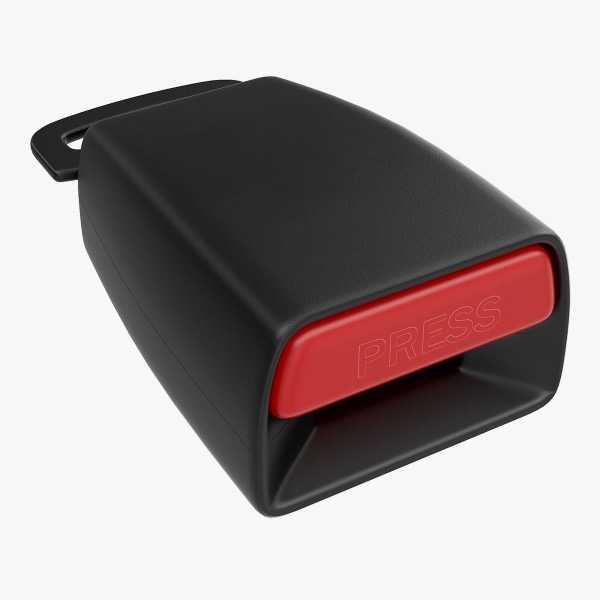
03Buckle body with press-release button
Category 03
The buckle is the part of a restraint that a person actually operates. It has to accept the latch plate with a clear, unmistakable engagement — one that can be felt and heard, not guessed at — hold it without slipping while load is applied, and release cleanly the moment the button is pressed.
Because it is used on every journey, engagement and release behaviour has to remain consistent over a very large number of cycles. A buckle that becomes stiff, or worse, becomes vague about whether it is latched, has failed even though nothing has visibly broken. Dimensional tolerance inside the buckle throat and on the mating latch plate is what keeps that behaviour stable.
Buckles are supplied as bodies for buyers assembling in-house, or already fitted to a stalk or webbing as part of a complete assembly.
Fig. 04 Retractor arrangementIndicative only
Category 04
A retractor stores webbing on a spool under light spring tension. That single mechanism does three jobs: it keeps the belt out of the way when nobody is using it, it keeps the belt sitting close to the body when somebody is, and it stops paying webbing out at the moment further payout would let the occupant move forward.
Spring force is a genuine design decision rather than a detail. Too little and the belt hangs slack and gets worn loose; too much and it drags on the shoulder until people route it out of the way or stop wearing it properly. Either outcome reduces the protection the assembly was designed to give, so retraction force is specified rather than left to chance.
Two locking behaviours are common. An emergency locking retractor allows the occupant to move normally and locks only in response to rapid webbing payout or vehicle deceleration. An automatic locking retractor locks at whatever length the webbing has been drawn to and will not pay out again until it is fully retracted, which is why it appears in some seating and child-restraint installations.
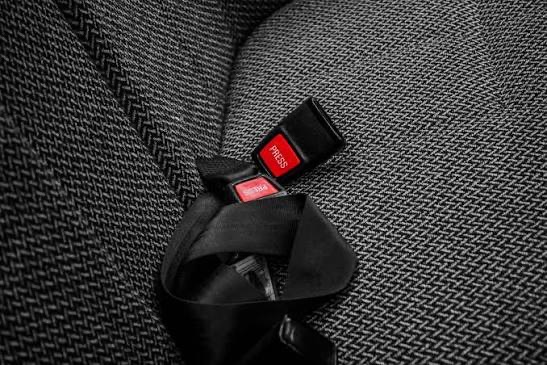
05Buckle stalks fitted at seat level
Category 05
Between the webbing and the vehicle sits a set of parts that rarely get discussed until one of them is wrong. They route the belt, set where it sits on the body, and carry load into the structure.
| Component | Function in the assembly |
|---|---|
| Latch plate | The tongue the occupant inserts into the buckle. Its slot holds the webbing and its blade has to match the buckle throat exactly. |
| Buckle stalk | Mounts the buckle at seat level on a short webbing or rigid stalk, so it falls where the hand expects it. |
| D-ring / pillar loop | Turns the webbing at the upper anchorage and sets the angle at which the shoulder belt crosses the torso. |
| Height adjuster | Allows the upper anchorage point to be moved so the belt clears the neck on shorter occupants and the shoulder on taller ones. |
| Anchor plate | The fitting that transfers load from the webbing into the vehicle structure at the floor or sill. |
| Fixings | Bolts and associated hardware matched to the vehicle's mounting points and thread specification. |
| Stopper button | Holds the latch plate at a convenient height on the webbing instead of letting it slide to the floor. |
Category 06
Most enquiries end up here. A seat exists, mounting points exist, and the belt has to work with both — which usually means configuring a product rather than picking one.
These are the variables we normally settle before quoting. You do not need answers to all of them to start a conversation — tell us what you know and we will work through the rest.
A
Three-point or two-point lap; retractor or fixed length; which seating position the belt serves.
B
Webbing lengths, stalk length, and the routing available between the anchorage points on the vehicle.
C
Latch plate style, buckle format, D-ring or height adjuster, anchor plate type.
D
Standard or high-visibility colour, and whether the belt needs to be visually obvious in use.
E
Bolt sizes and thread specification matched to the mounting points already on the vehicle or seat frame.
F
What records, markings or paperwork have to accompany the parts for your market and process.
We do not publish dimensional tables, load figures or test results on this website, because the correct values depend on the assembly and the regulation the vehicle is built to. Specifications are available based on application and project requirements, and are confirmed in writing before anything is manufactured.
Questions
General answers about seat belt products and how to specify them. For anything specific to your vehicle, send us the details.
A seat belt manufacturer produces the restraint assembly and the components inside it: woven webbing, retractors, buckles, latch plates, D-rings and height adjusters, anchor plates and the fixings that tie the assembly into the vehicle structure. Depending on the supply arrangement, a manufacturer may supply individual components, sub-assemblies, or complete belts ready to fit.
The two most common formats are the three-point assembly, which routes webbing across the shoulder and the lap and is standard in most forward-facing seating positions, and the two-point lap assembly, still used in some centre, bench and specialty seating positions. Multi-point harnesses are used where an application calls for additional restraint points. The right format depends on the seat, the mounting points available and the regulation the vehicle is built to.
Yes. Belt length, webbing colour, retractor type, latch plate style, buckle format, anchor geometry and fixing type can all be specified to suit a vehicle and a seating position. Customisation is normally driven by the mounting points available, the seat design and the regulation the vehicle is homologated against. Specifications are agreed per project — see Custom Restraint Solutions for the variables we work through.
Consistency between batches matters more than any single sample, so ask how the supplier controls incoming material, how assemblies are inspected, and what records are kept against a batch. Also confirm that the supplier understands the regulation your vehicle is built to, can hold a specification unchanged across a production run, and can communicate clearly about lead times and changes. Our approach to those points is set out under Quality & Safety.
Webbing is the load-carrying member of the restraint. It spreads force across the occupant's pelvis and rib cage rather than concentrating it, and its woven construction is designed to stretch in a controlled way so that deceleration is managed over a longer distance. Because it carries the load, consistency in width, thickness and weave is fundamental to how the whole assembly performs.
A retractor stores webbing on a spool under light spring tension so the belt stays out of the way when not in use and stays close to the body when worn. It pays webbing out as the occupant moves and locks the spool when it needs to stop further payout. Emergency locking retractors respond to rapid webbing payout or to vehicle deceleration; automatic locking retractors lock at a set position and are used in some seating and child-restraint applications.
The buckle is the connection the occupant makes and breaks on every journey. It has to accept the latch plate with a clear, unmistakable engagement, hold it without slipping while load is applied, and release cleanly when the button is pressed. Because it is operated constantly, engagement and release behaviour has to stay consistent over a very large number of cycles.
Send your requirement through the enquiry form on the contact page, email info@autogleam.in, or call +91 99206 38354. It helps to include the vehicle or application, the seating position, the belt format you need, approximate quantities and your timing.
Enquiries
Send the vehicle, seating position, belt format and quantity. If you are not sure of the format, describe the seat and we will work it out with you.